 Phoenix Terrazzo Restoration
Terrazzo Grinding and Polishing in Phoenix
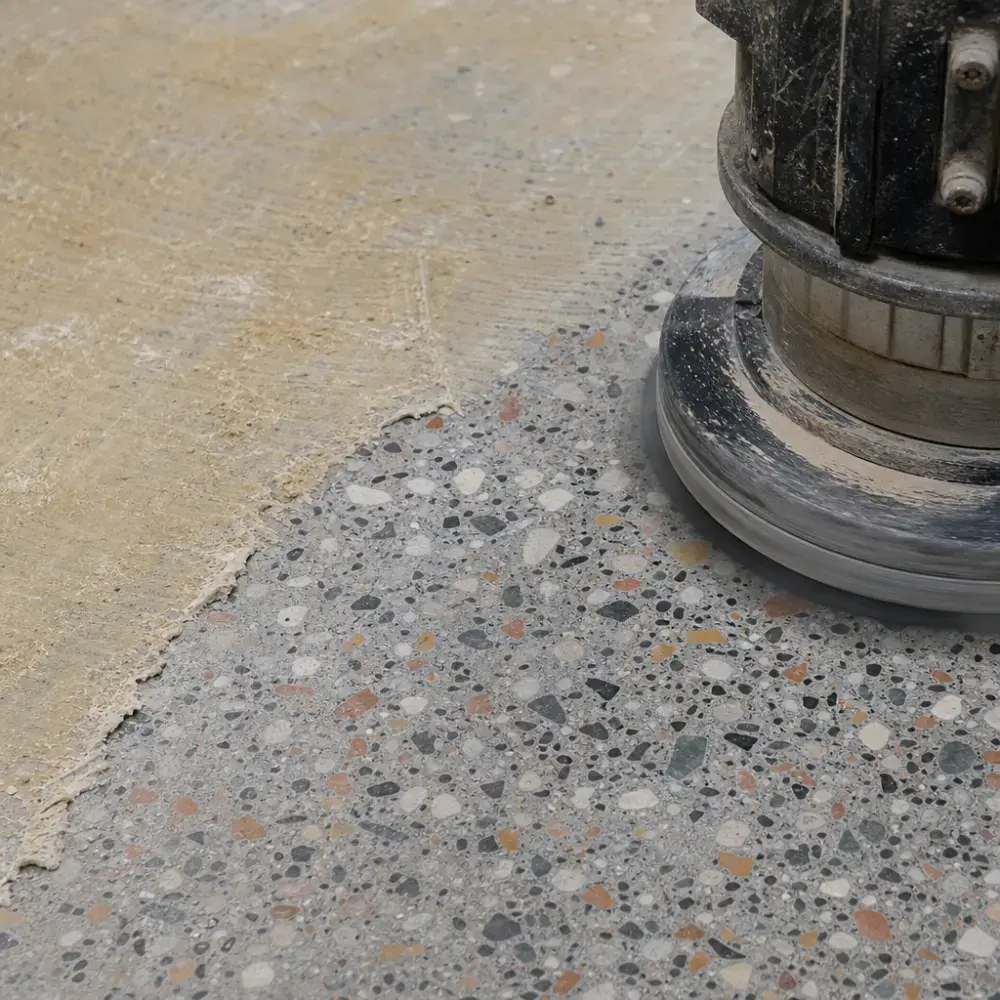
Terrazzo grinding and polishing in Phoenix typically runs $4 to $8 per square foot. Grinding cuts the floor flat and clean with coarse metal-bond diamonds, then polishing steps up through finer resin-bond diamonds until the stone has the sheen you want, from a soft honed satin to a high gloss. The shine comes from the stone itself. There is no wax or film on top, and that is the whole point.
This is the core of every terrazzo restoration. It is also the job on its own when a floor is already exposed but tired: scratched by years of grit, dulled by mopping, or wearing an old coating that has gone cloudy.
Grinding: the metal-bond passes
The first passes use a planetary grinder, which turns several diamond heads in one direction while the plate turns the other. That counter-rotation is what lets it cut a floor flat instead of following its dips. The NTMA restoration specification allows wet or dry grinding with appropriate diamonds; we grind wet or with a vacuum shroud and HEPA collection in an occupied house.
What the metal-bond passes do:
- Remove what is on top. Carpet adhesive, thinset residue, old wax, acrylic “shine” products, and urethane all come off here. If the old coating is thick, this is where the time goes.
- Remove what is in the top layer. Shallow rust rings from tack nails and appliance feet, dye bleed from carpet pad, and surface stains usually go in these passes.
- Flatten. Lippage between panels, raised patches, and worn traffic paths get cut level so the polish reads evenly across the room.
Grouting between grits
Grinding opens up pinholes and voids in the matrix. The NTMA specification calls for wet grinding with 50 grit or finer, then grouting with a cement or epoxy grout matched to the matrix color, then letting it cure at least 12 hours with the room held between 70 and 80 degrees, then a fine grind (120 grit carborundum or 200 grit resin-bond diamond) until the grout is off the surface. In a Phoenix summer, that temperature window is the scheduling problem. The house has to be cooled on grout day.
Polishing: the resin-bond passes
Resin-bond diamonds come in steps, each finer than the last. Every step removes the scratches of the one before it. Where we stop decides the look:
| Finish | Where we stop | What it looks like |
|---|---|---|
| Honed | Medium resin grits | Smooth, low sheen, hides scuffs, good in a busy entry |
| Satin | Middle of the range | Soft glow, the most common choice in a ranch house |
| High gloss | The finest grits | Reflective, shows the chips at their brightest |
A densifier can go on along the way to harden the cement matrix. Then a penetrating sealer finishes the job, covered on the sealing page. The NTMA notes gloss comes from polish and sealer together, so a floor polished to a satin will not become a mirror because of what goes on top.
When the floor only needs polishing
If your terrazzo is already exposed, flat, and coating-free, it may skip the coarse grind entirely and start in the resin-bond steps. That is common in a house where the terrazzo was never covered but has been mopped with the wrong products or scratched by monsoon grit. The dull and scratched page covers that symptom and when a lighter job is enough.
Phoenix things that affect the polish
- Dust storms. The monsoon officially runs June 15 through September 30, and the National Weather Service’s season brings dust storms that can rise to a haboob. The NTMA maintenance guide says grit “can lead to scratching of the finish which reduces gloss.” A high-gloss floor near a busy patio door will show that sooner than a satin one. Choose the finish for the room.
- Hard water. Valley tap water is very hard. Mopping a high-gloss floor and letting it air dry leaves spots that look like dullness. The NTMA says not to let cleaning solution dry on the surface and to dry the floor with cotton or microfiber.
- Heat. Polish itself does not care about the temperature, but the grout and sealer steps do.
Pricing
| Line | Typical range |
|---|---|
| Grind, grout, hone, polish, and seal | $4 to $8 per sq ft |
| Old coating removal (in the metal-bond passes) | Included; heavy coatings push toward $8 |
| High-gloss finish | Toward the top of the range |
| Minimum visit | $600 to $1,000 |
What puts a floor at $4: never coated, light glue, satin finish, open rooms. What puts it at $8: thick coatings, lots of edges and doorways, built-ins, and a high-gloss finish. Published guides back the range: HomeAdvisor lists terrazzo polishing and refinishing at about $4 per square foot, and one terrazzo polishing guide lists basic polishing at $4 to $8. The full table is on the pricing page.
To start, send a photo of the floor from standing height, a close-up of the worst spot, and the rough square footage. If the floor is still under carpet, the carpet, tile, and glue removal page covers that step first.
Frequently Asked Questions
What is the difference between grinding and polishing terrazzo?
Grinding uses coarse metal-bond diamonds to cut the floor flat and take off glue, coatings, stains, and the worn surface. Polishing, or honing, uses finer resin-bond diamonds in steps to bring the stone back to a smooth sheen. Every restoration does both; a floor that only needs a refresh may only need the finer steps.
How shiny can terrazzo get?
As shiny as you want to pay for. Stopping at a medium grit gives a soft, honed satin. Going up through the finer grits gives a high gloss. The NTMA maintenance guide notes gloss comes from the polish and the sealer together, so the shine is built into the stone, not painted on.
Can I rent a floor buffer and polish terrazzo myself?
A swing buffer with a pad can clean a floor, but it cannot flatten it, remove deep glue, or take out lippage between panels. Real grinding needs a planetary machine with diamond tooling, water or dust collection, and someone who knows when to stop. The NTMA maintenance guide also warns against overusing diamond pads in routine care.
Does grinding create a lot of dust?
It can, which is why we grind wet or with vacuum shrouds and HEPA collection. OSHA's construction silica rule lists integrated water delivery or dust collection for floor grinders. Dry sweeping and compressed air are restricted for the same reason.
More terrazzo services
- Terrazzo Floor Restoration in Phoenix
- Terrazzo Crack and Hole Repair in Phoenix
- Carpet, Tile, and Glue Removal Over Terrazzo in Phoenix
- Terrazzo Stain and Rust Removal in Phoenix
- Terrazzo Sealing and Maintenance in Phoenix
- Commercial Terrazzo Restoration in Phoenix
- Concrete Floor Grinding and Polishing in Phoenix (When the Carpet Comes Up on Concrete)
Areas we serve
- Phoenix, AZ
- Concrete and Terrazzo Floor Restoration in Maryvale
- Terrazzo and Floor Restoration in Sun City
- Terrazzo and Floor Restoration in Sunnyslope
- Terrazzo Restoration in Arcadia
- Terrazzo Restoration in Mesa
- Terrazzo Restoration in Paradise Valley
- Terrazzo Restoration in Scottsdale
- Terrazzo Restoration in Tempe