 Phoenix Terrazzo Restoration
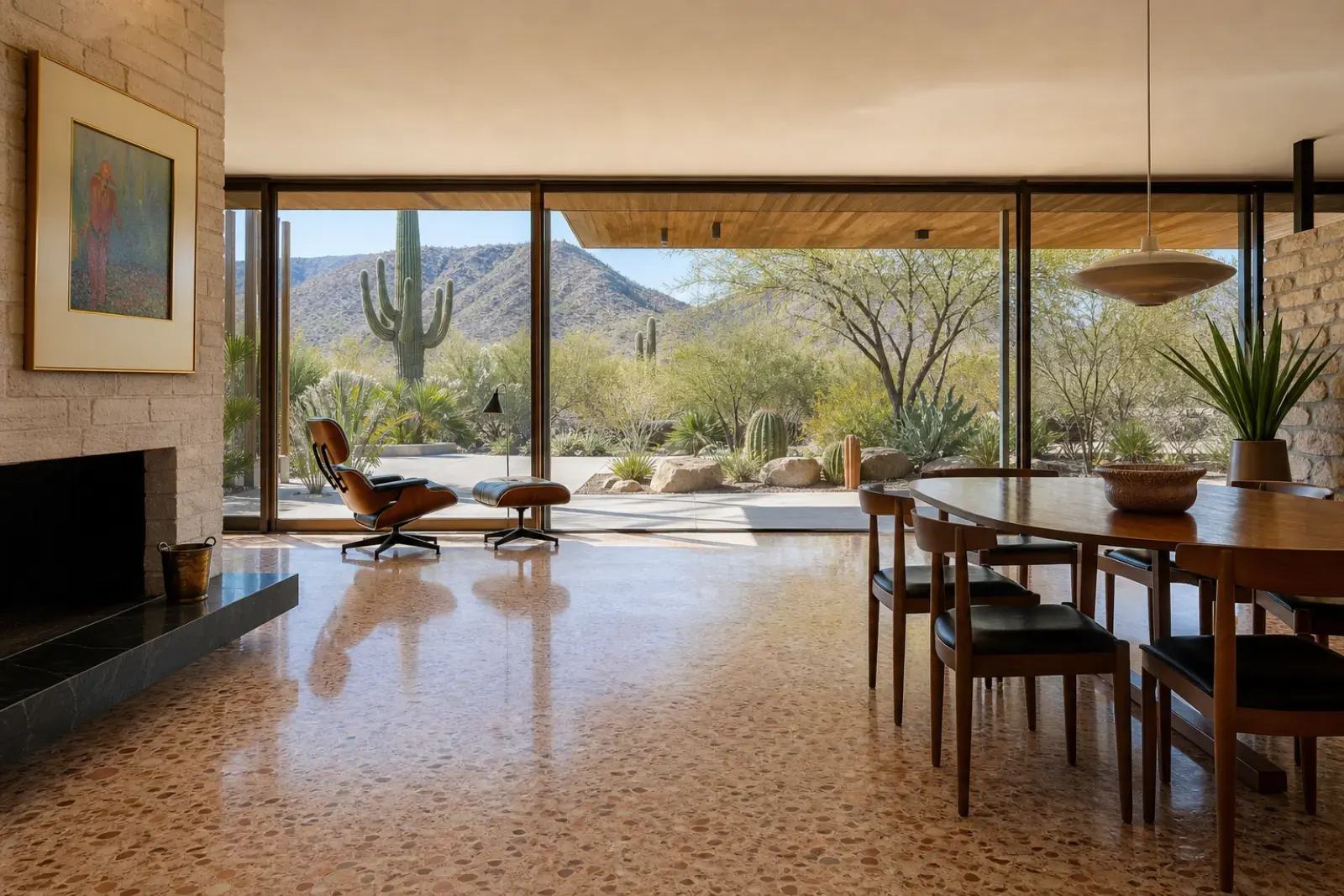
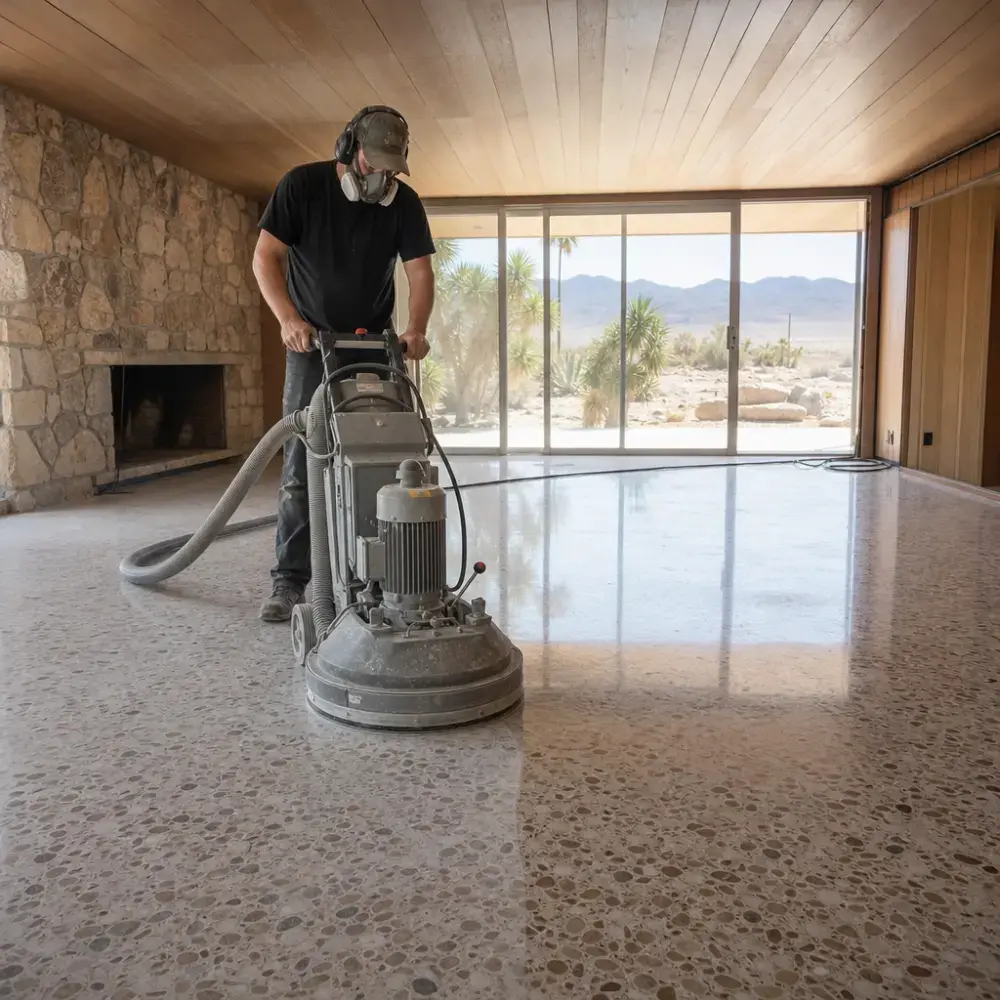
Phoenix Terrazzo Restoration grinds, repairs, hones, and polishes original terrazzo floors in Phoenix mid-century homes and older commercial buildings across the Valley. Grinding and polishing typically runs $4 to $8 per square foot, carpet and glue removal adds $1 to $3 per square foot, tile and thinset removal adds $4 to $6, and crack or hole patches run $75 to $250 each. A typical living-area job of 500 to 1,200 square feet lands between $2,500 and $12,000 all in, and more when a large floor is under tile. Send a photo of a corner under the carpet and we will tell you what you have and what it should cost.
We also want to be straight with you about one thing before you pull up anything. A lot of Valley ranch houses were built on plain concrete, and the terrazzo you are hoping for may not be there. If it is, we restore it. If it is not, the slab itself can be ground and polished with the same machines, and the concrete floor polishing page covers what that costs.
What we do
- Terrazzo restoration: the whole job, from pulling the carpet and tack strip to the final seal, for a floor that has been covered or neglected for decades.
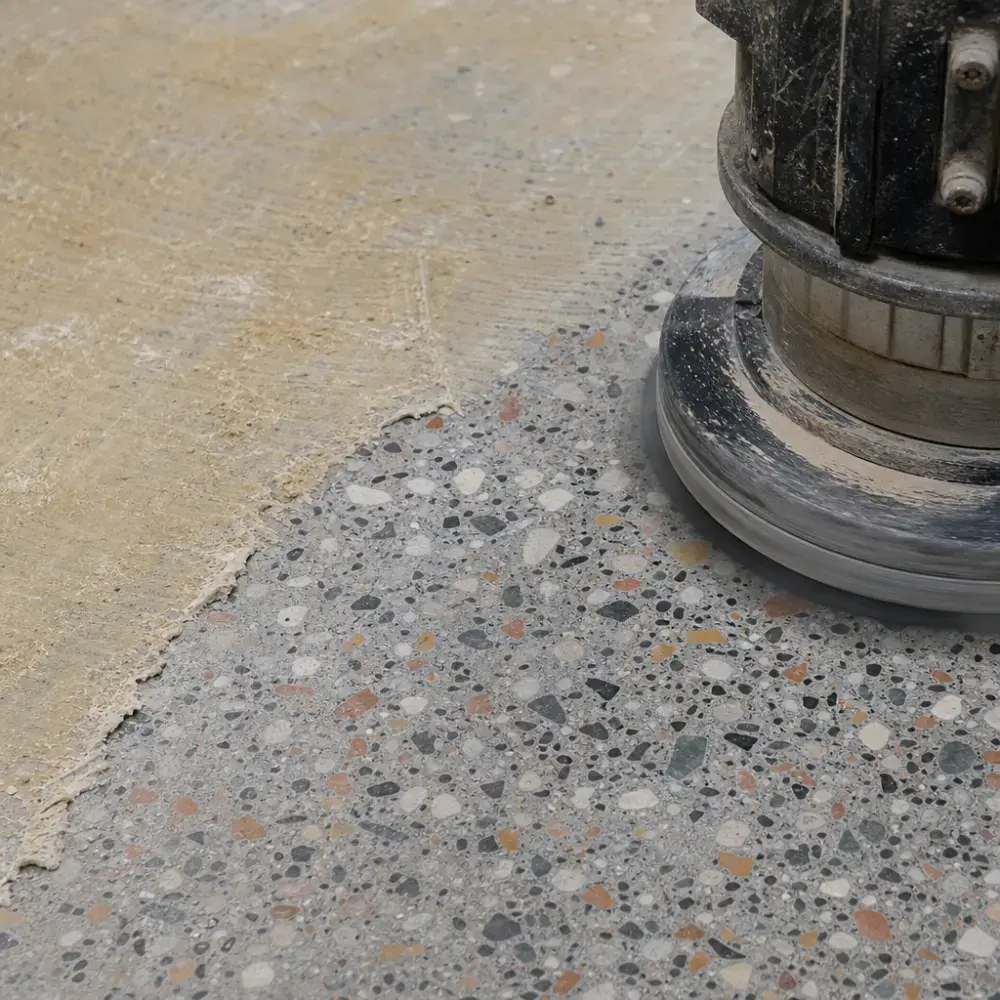
- Grinding and polishing: metal-bond diamonds to flatten the floor and cut through glue and stains, resin-bond diamonds to hone it up to a matte, satin, or high-gloss finish that comes from the stone.
- Crack and hole repair: cracks from a slab that moved, holes from tack strips and old plumbing, and trenches from removed walls, filled with matched marble chips and ground flush.
- Carpet, tile, and glue removal: carpet, pad, tack strip, tile, thinset, and black adhesive taken off without gouging the floor underneath.
- Stain and rust removal: rust from tack nails and appliance feet, pet stains, dye from carpet pad, with a straight answer about which ones will only lighten.
- Sealing and maintenance: a penetrating sealer and a care routine that holds up to monsoon dust and Phoenix tap water.
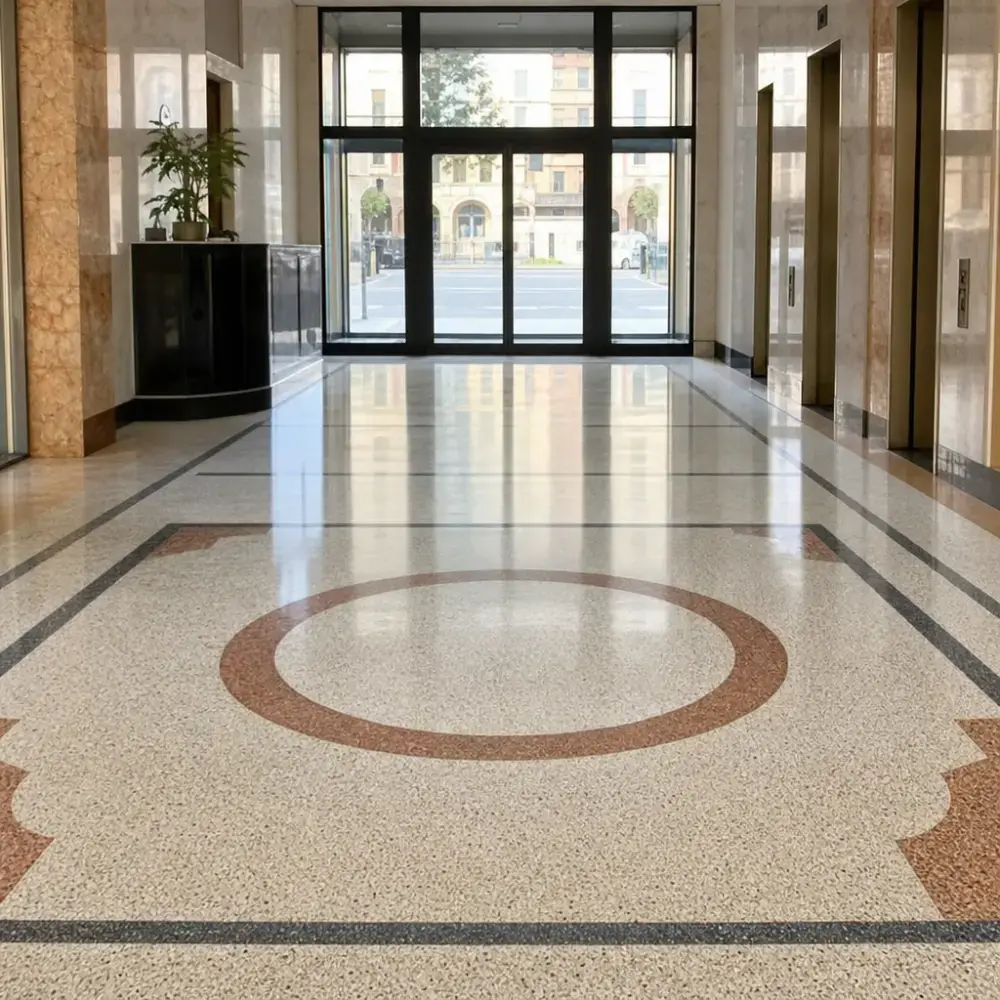
- Commercial terrazzo: lobbies, corridors, stair treads, schools, and churches, restored and kept on a maintenance schedule.
- Concrete floor polishing: for the house that came up concrete instead of terrazzo.
Where the terrazzo is in the Valley
The Phoenix area boomed after World War II. The City of Scottsdale’s historic context for its 1950s neighborhoods records Arizona adding almost 25,000 people a year in the 1940s and more than double that, about 55,000 a year, through the 1950s, with most of them settling around Phoenix or Tucson. By 1950 Phoenix had nearly 107,000 residents, Mesa almost 17,000, and Tempe 7,700. That same report is blunt about what most of those people moved into: “the typical postwar home was a single-level, Ranch Style house, with walls of concrete block, floors of concrete, and low-pitched roofs.”
So terrazzo in a Valley house is not the default. It is the upgrade. It shows up where the money and the architects were:
- Custom mid-century homes in the Camelback corridor and Arcadia. A 1960 house on East Marshall Avenue in the Camelback East area was listed for sale with “Terrazzo Floors Inside w/ a Scored Concrete Pool Surround.” One listing, but a useful picture of how custom builders used the material: terrazzo inside, scored concrete at the pool. The Arcadia page covers the citrus-grove ranches east of there.
- Upscale 1950s subdivisions. Tempe’s Date Palm Manor, Mesa’s Fraser Fields, and Paradise Valley’s large-lot homes were built for buyers paying above the going rate, and those are the kinds of houses where an upgraded floor is worth checking for. See the Tempe, Mesa, and Paradise Valley pages.
- Entries, halls, and living rooms. Even where a house has terrazzo, it may be only in the public rooms, with bedrooms on plain slab. That is why we price by the square foot of terrazzo, not the square footage of the house.
- Terrazzo tile. Some Valley homes have precast terrazzo tiles with brass or zinc strips rather than a poured floor. One Ralph Haver house near the Arizona Biltmore was listed with “terrazzo tile with brass spacer details in the kitchen and great room.” Tile and poured terrazzo restore differently, and the terrazzo tile page explains how.
Even Ralph Haver, the architect most tied to Valley mid-century tracts, designed at least some houses with bare concrete floors. A 1949 Haver house in Kensington Terrace was described as having “concrete floors” flowing through the main living spaces. Do not assume, check. The mid-century floors guide walks through how.
What a Phoenix floor usually needs
After the carpet or tile comes off, the list in this climate is predictable:
- Carpet glue and tack strip. Every perimeter has a row of nail holes, and many have a rust ring at each nail.
- Cracks from slab movement. The Arizona Geological Survey lists “heaving and cracking of floor slabs and walls” among the effects of the Valley’s problem soils. Terrazzo is bonded to the slab, so when the slab cracks, the terrazzo above it cracks too. The crack page explains which ones are still moving.
- A dull, scratched surface. Dust storms during the June 15 to September 30 monsoon season push fine grit indoors, and grit underfoot acts like sandpaper on a polished floor.
- Hard-water film. Phoenix tap water runs very hard, and mopping with it and letting it dry leaves a mineral haze. That one is a care problem, not a restoration problem, and the hard water page shows the fix.
- Old asphalt tile or black adhesive. Some 1950s Valley homes were sold with asphalt tile floors. If there is old tile or black mastic under the carpet, it gets tested before anyone grinds it, because the EPA lists floor tiles and their adhesives among products that may contain asbestos.
How we restore a terrazzo floor
- Expose and look. Carpet, pad, tack strip, and tile come up. We check chip size and color, the matrix color, cracks, loose sections, and any old coating before quoting the grind.
- Repair. Cracks and holes are cleaned out and filled with resin or matrix tinted to match, with marble chips in anything wider than a quarter inch, following the NTMA restoration specification.
- Grind. Metal-bond diamonds flatten the floor and remove glue, stains, coatings, and the worn top layer. We grind wet or with vacuum shrouds, because OSHA’s silica rule exists for a reason and you live there.
- Grout and hone. The floor is grouted to fill pinholes, the grout cures with the room kept between 70 and 80 degrees, and resin-bond diamonds take it up through the grits to the sheen you want.
- Seal. A penetrating sealer, applied to the manufacturer’s directions in thin coats. No wax, no acrylic, no urethane film.
Typical prices
| Work | Typical range |
|---|---|
| Grind and polish restoration | $4 to $8 per sq ft |
| Carpet, pad, tack strip, and glue removal | $1 to $3 per sq ft extra |
| Tile and thinset removal | $4 to $6 per sq ft extra |
| Crack or hole patch | $75 to $250 per patch |
| Stain and rust treatment | $150 to $600 per area |
| Sealing only, floor already restored | $1 to $2 per sq ft |
| Typical home, 500 to 1,200 sq ft of terrazzo | $2,500 to $12,000 |
| Minimum for one room or a repair-only visit | $600 to $1,000 |
| Commercial restoration | $4 to $10 per sq ft |
| Concrete grind and seal / polished | $2 to $5 / $4 to $10 per sq ft |
The full breakdown, and what moves each number up or down, is on the pricing page. You can also run your own floor through the cost calculator.
Who should do the work
Ask for an Arizona Registrar of Contractors license number, whoever you hire. Arizona’s handyman exemption only covers a project under $1,000 total, labor and materials, that needs no building permit, and anyone working under it has to say “not a licensed contractor” in their advertising. A terrazzo floor restoration is far over that line. The ROC’s CR-48 tile classification lists terrazzo in its scope, and the Residential Contractors’ Recovery Fund only pays out on work by a licensed residential contractor, which is one more reason to look the number up before you sign.
Then ask how they get the shine. If the answer is a coating, a “shine” product, or wax, that is not restoration. If the answer is diamonds and a penetrating sealer, keep talking.
Areas we cover
Central Phoenix and the Camelback corridor, Arcadia, Paradise Valley, Scottsdale, Tempe, Mesa, Sun City, Maryvale, and Sunnyslope. Wherever your floor is in the Valley, send the photo. Questions first? The FAQ and about page cover the rest.